
Financial success of Comprehensive Care for Joint Replacement (CJR) model paved way for TEAM


By Brian Murphy
The Comprehensive Care for Joint Replacement (CJR) model is over, and it generated savings to Medicare. How much?
We await the grand total, as final performance year financial results are expected later this year.
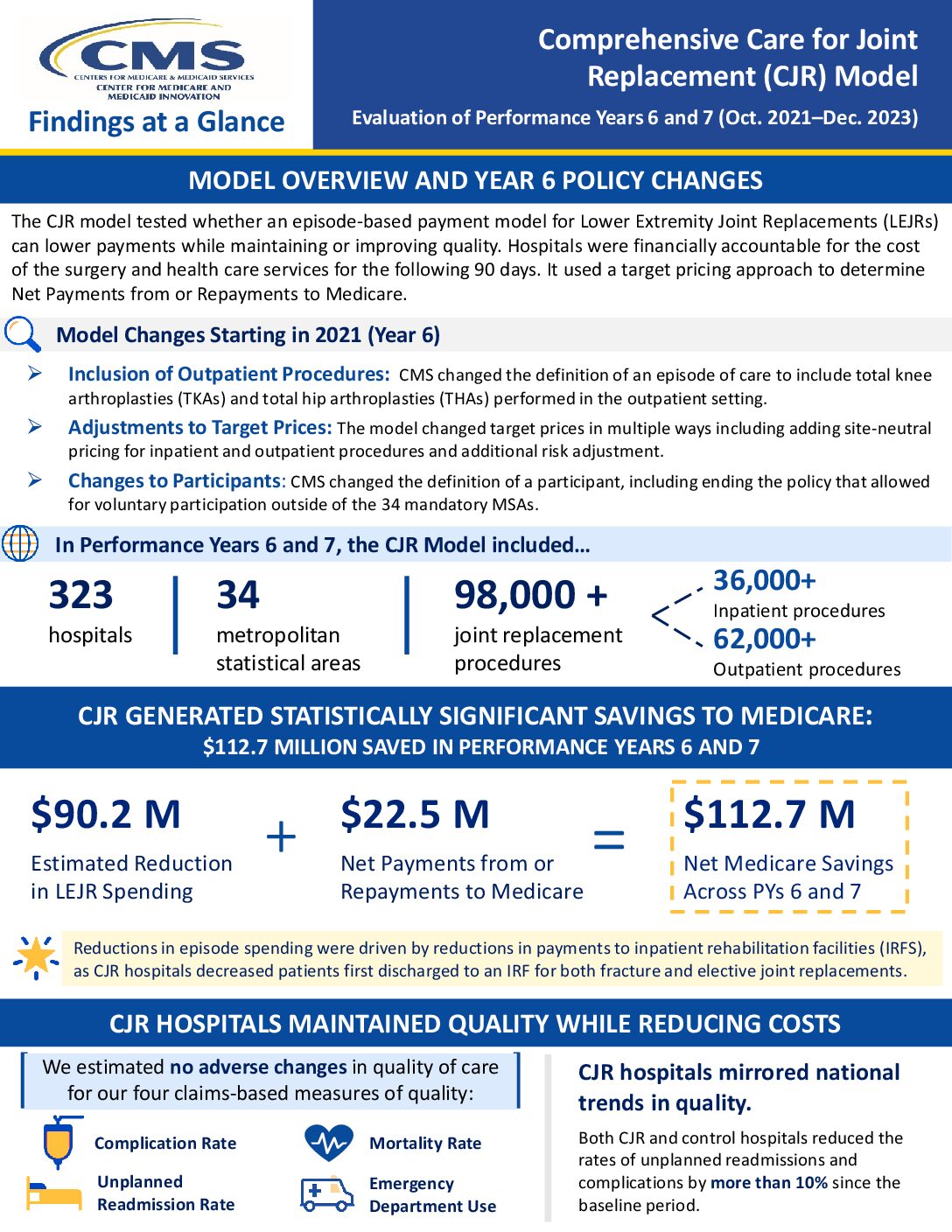
But the latest, just released data (see attached graphic) shows that the CJR generated a whopping $112.7 million in net Medicare savings across performance years 6 and 7.
CJR success extended beyond financial savings. CMS estimated no adverse changes in quality of care, as measured by complication rates, mortality, unplanned readmissions, or ED use, for CJR participants.
I’d call that a success. And I’m sure it’s why we’ve moved on to an even more ambitious bundled payment program in TEAM, which started Jan. 1.
A quick recap of what the CJR was all about.
The CJR lasted eight years–performance period began on April 1, 2016, and ended on December 31, 2024.
It was launched to improve care for Medicare patients undergoing hip and knee replacements (also called lower extremity joint replacements or LEJR) performed in the inpatient or outpatient setting, and for total ankle replacements performed in the inpatient setting.
The CJR’s bundled payment model encouraged hospitals, physicians, and post-acute care providers to work together to improve the quality and coordination of care from the initial hospitalization or outpatient procedure through recovery.
CMS provided participant hospitals with a target price for each MS-DRG in the model (469-470, and 521-522), prior to the start of each performance year. Following the end of a model performance year, actual total spending for the episode was compared to the target price.
Depending on the hospital’s quality and episode spending performance, the hospital could receive an additional payment from Medicare, or be required to repay Medicare for a portion of the episode spending.
In short, skin in the game. This is how all shared savings programs should operate.
CDI and coding professionals played a critical role in CJR performance. They ensured the clinical realities of patient care were faithfully translated into the coded data on which the entire model depended. Their work helped hospitals portray accurate risk, cost, and quality.
Accurate DRG assignment and ICD-10-PCS coding for the procedures themselves are obvious ways CDI and coding professionals played a role. Less obvious but equally important was capturing comorbidities to reflect unrelated readmissions, raise target prices, identify complications, and reduce unwarranted penalties.
(if you’re reading this, and did this work, bravo).
***
What happens next?
TEAM, which is currently in play. See below for an article explaining what this more complex and far-reaching bundled payment program entails.
We sometimes dump on CMS but I think they deserve applause for the CJR. It not only saved money, but also informed TEAM. Healthcare has much “defragging” to go but the CJR was an important step toward a fix.
What are your thoughts on the CJR, TEAM, and bundled payment initiatives more broadly?
References
- CMS, Comprehensive Care for Joint Replacement Model: https://www.cms.gov/priorities/innovation/innovation-models/cjr
- CMS, CJR Evaluation of Performance Years 6 and 7: https://www.cms.gov/priorities/innovation/data-and-reports/2025/cjr-fg-seventhannrpt
- Norwood, CMS TEAM: What it is, how it works … and why I’m an advocate: https://www.norwood.com/cms-team-what-it-is-how-it-works-and-why-im-an-advocate/
Related News & Insights
Should you follow the ACDIS/AHIMA query brief? I say yes: Here’s why.
By Brian Murphy Should you follow the ACDIS/AHIMA query brief? <= Not rage-bait, honest question. Earlier…

Fifth Universal Definition of Myocardial Infarction (MI) published: What it says for your CDI, coding, and clinical teams
The Fifth Universal Definition of Myocardial Infarction (MI) has been published in the Journal of the American…