
Posts by Brian.m
Who Owns Sepsis? The Battle to Define a Deadly Condition

By Brian Murphy, host, Off the Record podcast Listen to the episode here. CDI, coding, and clinical medicine are involved in a tug-of-war over a complex, life-threatening medical emergency that seems resistant to all forms of consensus. I’m talking about sepsis of course, and on today’s show I got to talk about sepsis with someone…
Read MoreDownload Coding in the Gray: Why Human Judgment Still Matters (part 2 of a 2-part series)
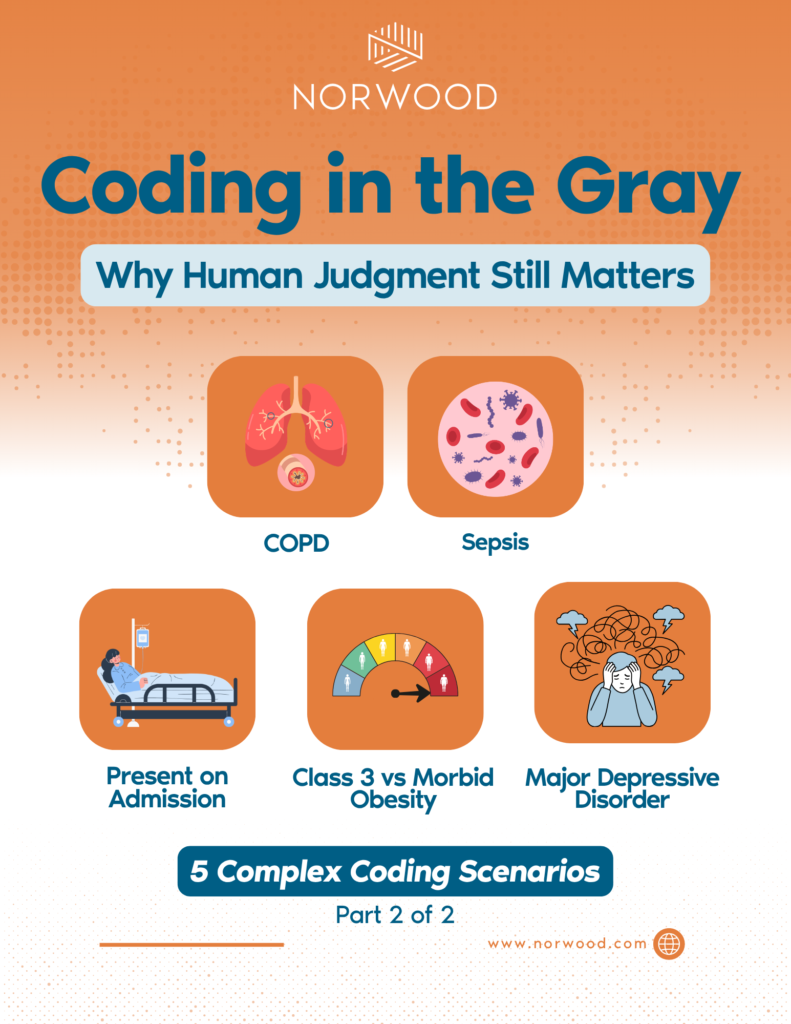
Download the report on our resources page. There is a LOT of talk these days about automation. Autonomous coding solutions that can code with near-perfect accuracy—and no human intervention. Providers picking a code from a drop-down menu, enabled by a computer-generated prompt, and voila: Maximized billing and denial-proof revenue. We’re not buying it. We’ve been…
Read MoreHow Norwood changed an organization’s CMI trajectory–to the tune of $2.56M
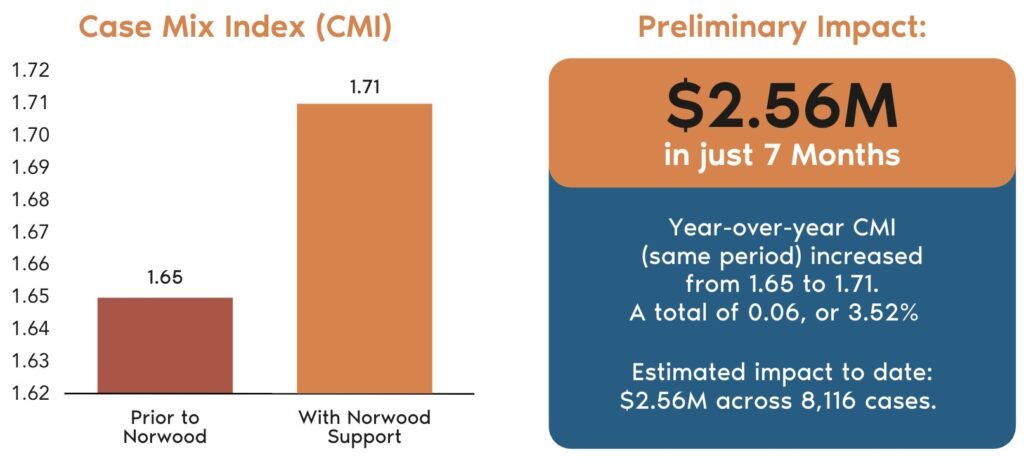
A drop in case mix index (CMI) isn’t necessarily indicative of a problem. A high-performing surgeon leaves your hospital, observation cases tick up seasonally, and you get a short-term drop. But flagging CMI over time warrants a closer look. Last year Norwood was asked to partner with an organization to focus on assessing and improving CDI performance. The CFO asked for an initial focus on CMI lift after long-term financial concerns. Norwood placed a three-person team to help…
Read MoreCC/MCC changes in 2027 IPPS final rule: We summarize them for you

The 2027 IPPS final rule includes several CC/MCC reimbursement changes to diagnoses you should be aware of. Watch for these in the documentation and report them and/or query if clinical indicators present. An audit now to confirm their presence or absence is a good strategy. They take effect Oct. 1. For example, hypoglycemia (i.e., low…
Read MoreThe OIG audited 21 specific DRGs—and found heavy error rates with these four
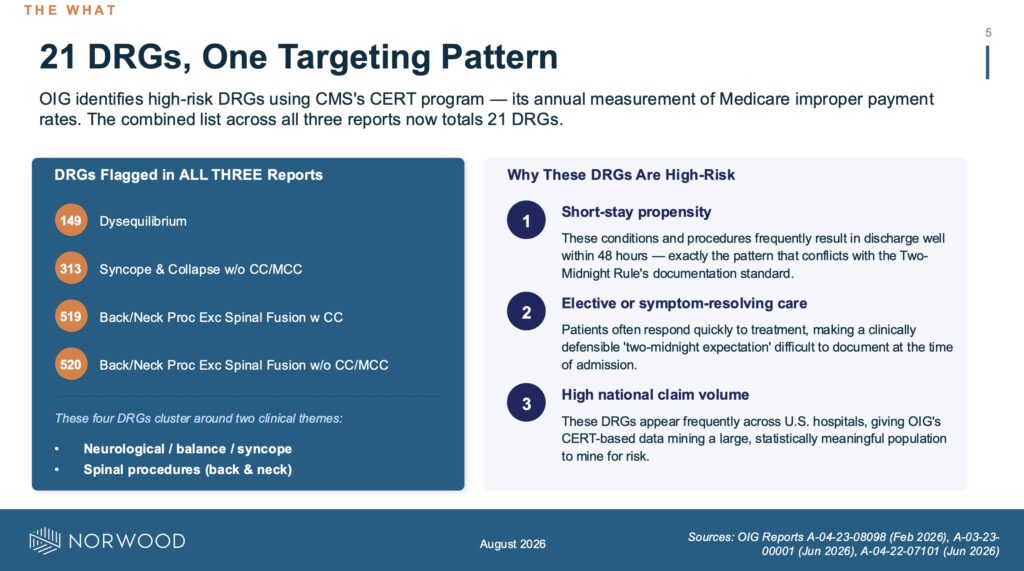
The Office of Inspector General (OIG) released results of three acute care hospital audits with a combined $35M in recommended recoupments. 21 specific DRGs were the target, four of which landed squarely in the bullseye. SVP of Solutions Jason Jobes identified the OIG’s targets, methodology, findings, explained their extrapolation methodology, and offered strategies for risk…
Read MoreLessons from loss: A look from the inside of value-based care with Rose Bernards

Listen to the podcast. Rose Bernards is a believer in value-based care. It’s been a driving force in her career. But it was put to the test when she suffered a family tragedy in late 2025. She wrote about that experience in a three-part series for LinkedIn I highly recommend: The Good, the Bad, and the Ugly. Link in the show notes. We get into those ups and downs, Rose’s wide-ranging educational career, and expert insights and…
Read MoreOIG offers clinical scenarios that can illuminate your own audit vulnerabilities

The recent Office of Inspector General (OIG) audits of three acute-care hospitals offer a goldmine of clinical/coding examples that you should be using for pre-emptive audit defense. Validating DRG assignments, reviewing medical necessity documentation completeness, and educating providers before an auditor comes knocking—and uses extrapolation to greatly increase recoupments. Here are examples taken from the…
Read MoreInpatient Audit Storm Clouds

Download the report on our resource page. The Office of Inspector General (OIG) never rests. After taking on Medicare Advantage organizations and aggressive risk adjustment coding practices from 2023-2025, the sights of the nation’s regulatory watchdog have shifted. The new target? Acute care hospitals and inpatient admissions. Plus some other outpatient odds and ends. This…
Read MoreTwo reasons why the 2027 OPPS proposed rule hurts your hospital
By Brian Murphy The 2027 OPPS (outpatient) proposed rule landed just prior to the July 4 holiday weekend. CMS’ timing is conspicuous, presumably to dodge the tomatoes hurled at it from the likes of the American Hospital Association. Not a whole lot of great news in here for healthcare orgs; here are two and…
Read MoreYou should be billing G2211 in heavy volume, per CMS
Who remembers G2211? Starting in 2024 this CPT code took the mid-revenue cycle by storm. Despite paying very little ($16.04) it was intended to be used in quantity. It has been. A new study by the Journal of the AMA found that its first year of full use, calendar year 2024, G2211 was billed 26…
Read More