
Do hospital ratings matter? Here’s what your peers say


By Brian Murphy
Hospital ratings: Does anyone care?
Healthgrades earlier this year announced its top 50, top 100, and top 250 hospitals awards. Links below; do you see your home state or hospital represented?
Some heavy hitters made the Top 50 Hospitals list (though none from my home state of MA, which is traditionally known for great care… time to move?). These include the likes of Mayo, Cedars-Sinai Medical Center, Scripps Mercy, AdventHealth, Emory, Johns Hopkins Bayview, Ascension, Stony Brook University NYU Langone, Mercy Health, Houston Methodist, and others.
Bigger question: Do you care?
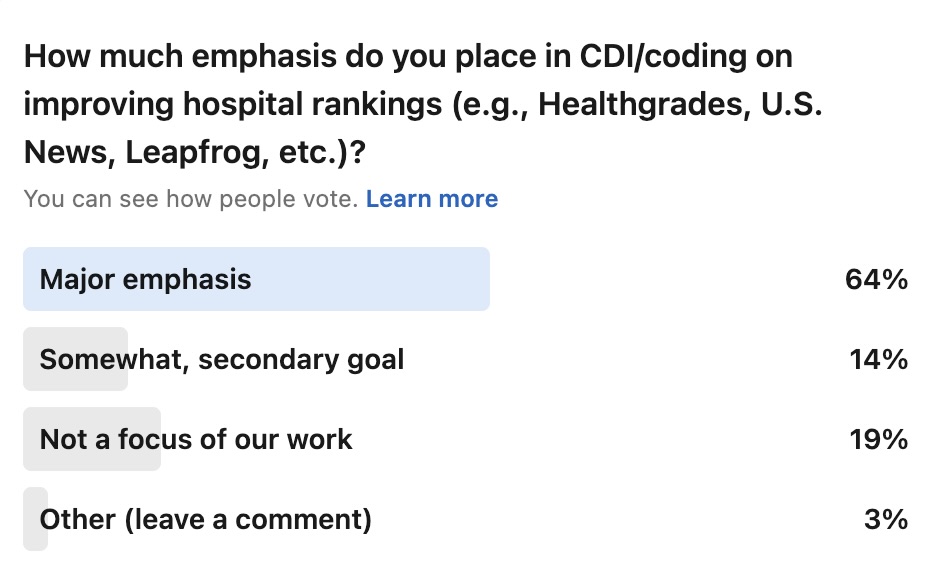
I asked this question two years ago and decided it was time to gather fresh data. Here are the results; a resounding yes (for most). 64% of respondents indicated that improving rankings was a major emphasis compared to just 19% who reported “not a focus of our work.”
Screenshot
Here’s how these results stack up against the same poll I asked in 2024; clearly they are growing more important each successive year. Not a huge surprise given the ongoing shift to value-based care.
2024 poll results
- Major emphasis: 34%
- Somewhat; secondary goal: 23%
- Not a focus of our work: 40%
- Other: 3%
A recent Healthgrades survey found that 76% of consumers would only choose a hospital with high quality ratings for their condition or procedure. Some hospitals in competitive markets pin copies of their Healthgrades placement on their bulletin boards, in their email signatures, or take out newspaper ads and buy billboard space on major interstates to celebrate wins.
Poor rankings make the knives come out.
Leapfrog, a privately held company that rates hospitals on a traditional grading system based on quality and safety recently ended up in hot water when it rated 5 Tenet hospitals as a D or F. Tenet successfully sued, and a judge ordered Leapfrog to pull its poor ratings and refrain from scoring those hospitals using its current or similar methodology.
Working behind the scenes on these grades are mid-revenue cycle professionals, many of whom take these ratings very seriously.
Healthgrades performance is based on clinical excellence using analysis of 31 risk-adjusted mortality and complication rates for common procedures and conditions: COPD, heart attack, heart failure, coronary interventional procedures, respiratory failure, pneumonia, sepsis, and others. In-hospital complications-based procedures and conditions include hip fracture treatment, back and neck surgeries, total hip and total knee procedures, and more.
Risk-adjusted mortality and complication rates are tracked using MedPAR data and a documentation clarification leading to a more accurate code assignment can move a patient in and out of a measure. So while actual clinical care is a huge factor in Healthgrades performance, so is the work of coding and CDI.
We believe rankings should be an emphasis. Organizations must put as much, if not more emphasis, in driving improved care outcomes. We can only document the E (expected) in the O-E ratio so much. At some point in time the O (observed) must improve.
References
- Fierce, Leapfrog ordered to remove safety grades for 5 Tenet hospitals: https://www.fiercehealthcare.com/providers/leapfrog-ordered-remove-safety-grade-5-tenet-hospitals
- Healthgrades 2026 Hospital Ratings Awards: https://www.healthgrades.com/quality/hospital-ratings-awards
- How Healthgrades rates America’s Best Hospitals: https://b2b.healthgrades.com/insights/blog/how-healthgrades-rates-americas-best-hospitals/
Related News & Insights
Nearly 80% of hospitals subject to HRRP hit with readmissions penalties
By Brian Murphy New data just released (see Fierce Healthcare article below) shows that CMS penalized a…

CDI chart review metrics: Worth tracking anymore?
By Brian Murphy Are CDI chart review productivity metrics outdated and in need of replacing? They’ve been…