
How has year one of new CMS TEAM value-based care payment model gone for your organization?
Posted November 4, 2026


By Brian Murphy
How is year one of TEAM going?
Admission: I’m pro-TEAM. It’s possibly the name but I favor the concept of the new CMS payment model, too.
We keep spinning our wheels on the fee-for-service treadmill, which incentivizes volume and often results in unnecessary and fragmented care. Everyone complains about FFS and TEAM is a compelling attempt at something new.
To recap:
- TEAM=Transforming Episode Accountability Model. We’ll never remember; just say TEAM.
- TEAM is a five-year demonstration. It started Jan. 1, 2026, and ends on Dec. 31, 2030.
- It’s mandatory. A subset of acute care hospitals are selected for inclusion, but those that are selected must participate.
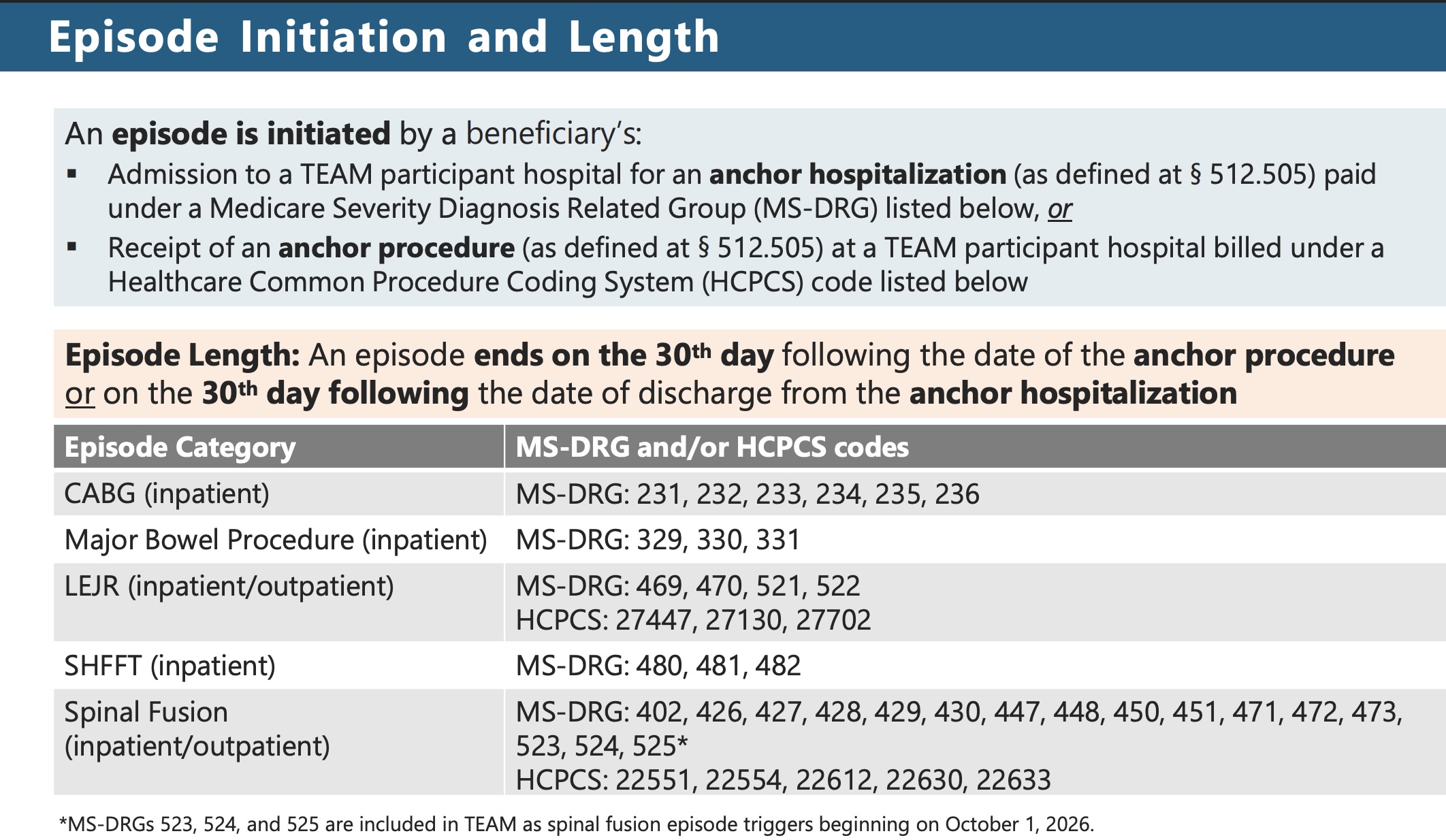
- The model pertains to five broad “episode categories” that begin with one of the following procedures: coronary artery bypass graft (CABG), lower extremity joint replacement (LEJR), major bowel procedure, surgical hip and femur fracture treatment (SHFFT), and spinal fusion.
- I’ve included a helpful table of the included MS-DRGs and HCPCS codes in these episodes.
- IMPORTANT NOTE: MS-DRGs 523, 524, and 525 are new, included in TEAM as spinal fusion episode triggers as of Oct. 1, 2026.
- CMS assigns each of these episodes a target price.
- Hospitals are responsible for overseeing a patient’s care from hospital admission or outpatient procedure through 30 days after the individual leaves the hospital, including coordination and communication between providers across all care settings and with the patient and family. This is where TEAM (and your care teams) kick in.
- TEAM participants and all Medicare providers and suppliers associated with an episode will continue to bill Medicare FFS, as usual. They will get paid as usual…
- … but, if participants perform well in the model, they may earn an additional payment. What does “performing well? mean? Spending below CMS’ target price for these episodes. If participants perform poorly (i.e., spend above the target price), they will likely owe CMS a repayment amount.
- TEAM is risk adjusted, to include factors like patient age and social risk, as well as comorbidities. V28 of CMS-HCCs will be used as the risk adjustment model.
- Risk adjustment begins with dx codes reported 180 days before the IP admission. This is a change; CMS initially proposed a 90-day window. You’ll need your CDI team to identify, get documented, and code the diagnoses before the IP stay begins. If you only perform concurrent CDI you’ll need to change your “old school” workflow to prospective.
- Questions? CMS has a dedicated email address: CMMI_TEAM@cms.hhs.gov
Would love to know how Year 1 is going for those participating in TEAM. Love it or hate it, send me a comment at brian.murphy@norwood.com.
Screenshot
References
- CMS, TEAM Model Overview: https://www.cms.gov/priorities/innovation/files/team-overview-updated.pdf
- CMS, TEAM Model webpage: https://www.cms.gov/priorities/innovation/innovation-models/team-model
Related News & Insights
Chad needs your help: How your organization can capture metabolic syndrome
By Rose Bernards “Chad” is a fictional person and moniker for cholesterol, hypertension and diabetes. Chad…

August audit heat: False Claims Act settlements put spotlight on upcoding
Listen to the episode here. This episode of Off the Record is a bit of a departure:…