
From Encephalopathy to Edema: Talking chart review with Dr. Tarman Aziz


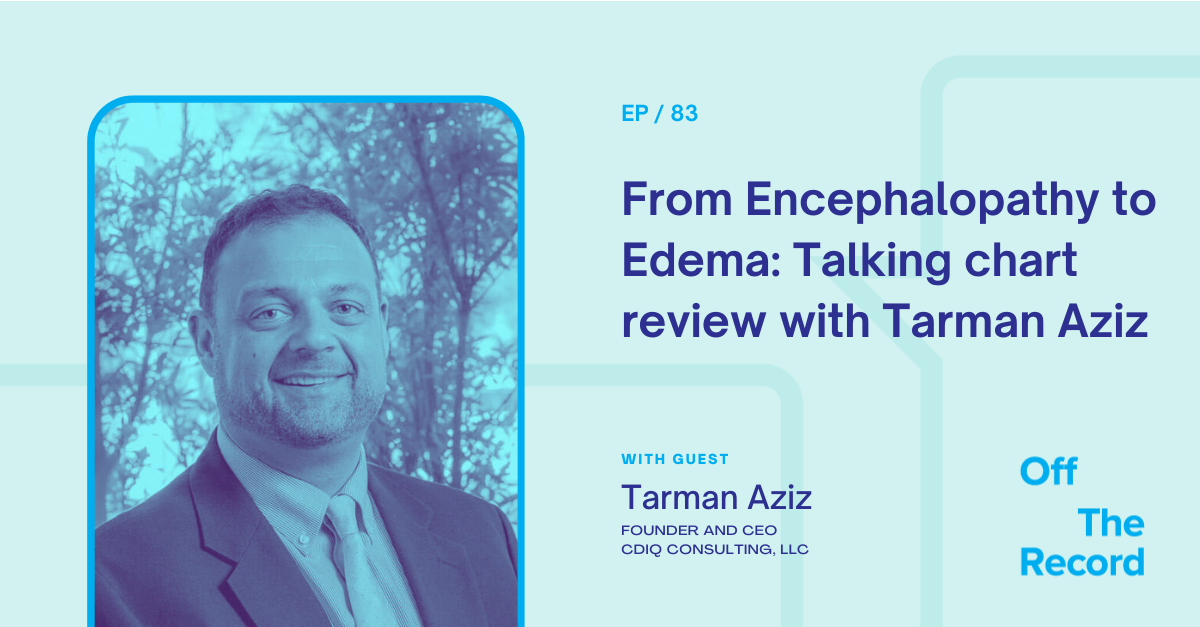
I’m consistently surprised at how few CDI or IP coding professionals talk about their most basic job function. The very reason they are hired, and what most do for eight hours a day.
I’m talking about chart review.
Go on Linkedin or Facebook and it’s rarely discussed.
Yet it’s … everything. Nuanced, complex, clinical, critical to the quality of financial health of hospitals. It’s how patient acuity is expressed in coded data, how hospitals get paid, and why CDI and coding professionals are employed.
I’ve heard it described as akin to detective work, puzzling together the pieces and presenting an informed query to the provider. Yet like detective work it often remains a mystery.
Dr. Tarman Aziz joined me to open up that conversation. He is founder and CEO of CDIQ Consulting, LLC, a physician-led healthcare education and consulting firm focused on closing the gap between clinical reality and coded data. On this episode of #OTR we discuss:
- Is chart review unique to the individual/healthcare organization/assistive tech, or are there underlying principles everyone can follow?
- How evolving clinical indicators in a case drive a concurrent CDI workflow—the differences of reviewing a chart at 24 vs 72 hours as clinical indicators morph
- How early is too early to look at an inpatient chart?
- Underutilized and underrated areas of the health record
- Review strategies for encephalopathy, dehydration, hyper- and hyponatremia, and cerebral edema/compression
- Tarman’s work consulting and educating non-traditional CDI candidates
- The remarkable story of Tarman’s fiancé Anna, an 11-year survivor of Stage 4 breast cancer
Related News & Insights
Fifth Universal Definition of Myocardial Infarction (MI) published: What it says for your CDI, coding, and clinical teams
The Fifth Universal Definition of Myocardial Infarction (MI) has been published in the Journal of the American…

Who Owns Sepsis? The Battle to Define a Deadly Condition
By Brian Murphy, host, Off the Record podcast Listen to the episode here. CDI, coding, and clinical…